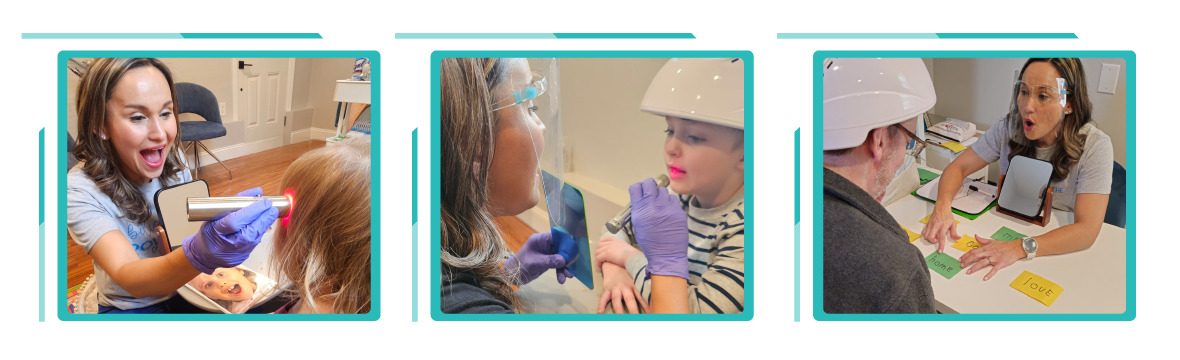

Meet GW.
GW experienced a severe stroke that resulted in Expressive Aphasia and Apraxia, robbing him of his ability to speak. For over 18 months, he worked hard in traditional speech therapy, yet his verbal output remained limited to just three words: “this,” “yes,” and “no.” Imagine the isolation, the frustration, the feeling of being trapped inside your own mind with no way out.
Everything changed when GW began Transcranial Photobiomodulation (tPBM)—a form of red light therapy—in combination with targeted speech therapy.
From the very first session, GW began making progress. Here’s what happened:
- Session 1: Vocalic sounds (vowel-like utterances) started to emerge.
- Session 3: Vocalic and consonant sounds, along with word approximations, began developing with visual and verbal support.
- Session 10: GW was now producing 10 new words and even saying the full phrase, “Hi, I want more,” when supported visually and verbally.
His transformation didn’t stop there—GW continues to make strides every single week.
So, what is red light therapy doing here?
Transcranial Photobiomodulation (tPBM) uses low-level red or near-infrared light to stimulate brain function and increase cellular energy (ATP production), blood flow, and neuroplasticity. When paired with skilled speech therapy, it appears to “unlock” parts of the brain that were previously dormant or disconnected—helping patients access language in ways traditional therapy alone couldn’t.
If you or a loved one is living with Aphasia or Apraxia after a stroke and traditional therapy hasn’t delivered the results you hoped for, it might be time to try something new.
Are you ready to try something different and get REAL results? Contact us today!
